
Sunbula
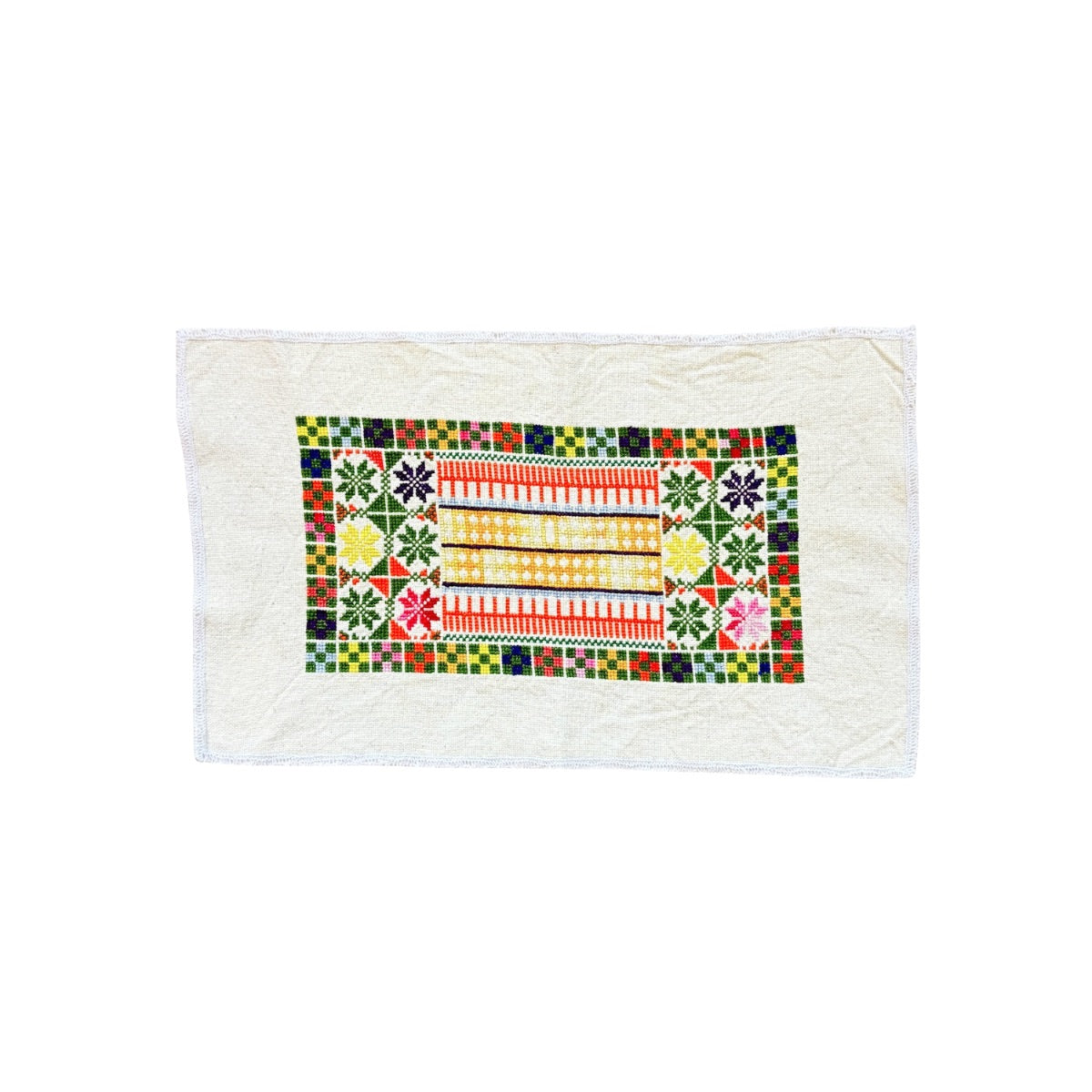
Embroidery Piece Designed by Sliman Mansour - Olive
SKU: EPU513Embroidery Piece Designed by Sliman Mansour - Olive
Regular price
$38.00 USD
Regular price
Sale price
$38.00 USD
Shipping calculated at checkout.
Couldn't load pickup availability
Designed by beloved Palestinian artist, Sliman Mansour. Hand-embroidered and ready to be framed and hung on a wall or perfect as-is for adorning a tabletop. Made of Mansouri cotton which is woven in Palestine. Size: 14 x 9 (in) | 35 x 23 (cm)
Surif Women's Cooperative
The village of Surif (pop. 15,000) is located alongside the Green Line (1949 Armistice Line separating West Bank and Israel), in a beautiful hilly region between Bethlehem and Hebron. About half of the village population is refugees from the 1948 war, forced to flee their homeland that later became a part of the State of Israel.
In 1950, a group of Mennonite volunteers came to the village to establish the Palestinian Needlework Program, in order to give the refugee women an opportunity to supplement their family income and to enhance their own self-reliance through empowerment. In 1979, the village women took over the responsibilities to run the project, which, after a period of intensive training, was reborn as Surif Women's Cooperative, in 1983.
Surif's Women's Cooperative is known for their distinct style, using cream-colored 'mansouri' cotton fabric instead of the popular 'eitamin' cross-stitch canvas. The embroidery patterns are produced by a system of counting threads, a method that gives the embroidery its striking and exact appearance on both sides of the fabric. Surif's designs are adapted from traditional Palestinian dresses and reflect the heritage from different regions of Palestine.
In 1950, a group of Mennonite volunteers came to the village to establish the Palestinian Needlework Program, in order to give the refugee women an opportunity to supplement their family income and to enhance their own self-reliance through empowerment. In 1979, the village women took over the responsibilities to run the project, which, after a period of intensive training, was reborn as Surif Women's Cooperative, in 1983.
Surif's Women's Cooperative is known for their distinct style, using cream-colored 'mansouri' cotton fabric instead of the popular 'eitamin' cross-stitch canvas. The embroidery patterns are produced by a system of counting threads, a method that gives the embroidery its striking and exact appearance on both sides of the fabric. Surif's designs are adapted from traditional Palestinian dresses and reflect the heritage from different regions of Palestine.